












Tubes & Test Tubes

-

-

-

-

-

-
-
-

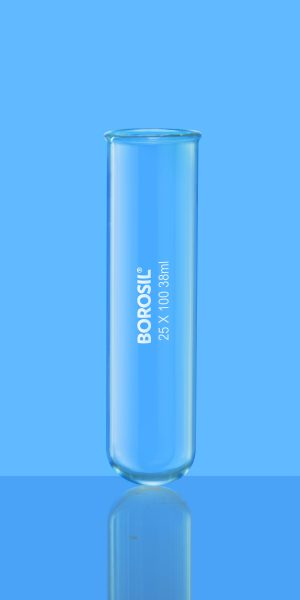
9835 – Cod Digestion Tube
• Made from thick-walled and mechanically resistant borosilicate glass• Used in COD disintegrationView Details -

Types of Test Tubes
Borosil Scientific test tubes are classified by shape, closure, calibration, and use case.
General Laboratory Tubes
| Model No. | Type | Base | Rim | Stopper | Notes |
| 9800 | Test Tube | Round | Yes | No | General purpose |
| 9820 | Test Tube | Round | No | No | Smooth edge, automated workflows |
| 9829 | Test Tube | Round | No | I/C Glass Stopper | Chemical-resistant, for short-term storage |
| 9830 | Graduated Test Tube | Round | No | I/C Glass Stopper | Calibrated, chemical and light stable |
| 9831 | Graduated Test Tube (Amber) | Round | No | I/C Glass Stopper | Suitable for photosensitive compounds |
Graduated test tubes provide volume tracking. The 9830 and 9831 models have precise, permanent graduations and are available with interchangeable stoppers to prevent contamination or evaporation.
Flat Bottom Tubes
Flat-bottom tubes are used for colourimetric testing, slower reactions, or incubation protocols.
- 9821 – Flat bottom, without rim
- 9822 – Flat bottom, with rim
Both are suitable for work requiring upright placement without a rack. Typically used in QA labs where space constraints exist or for visual comparison of multiple samples side by side.
Special Purpose Tubes
| Model No. | Tube Type | Design Feature | Application |
| 9835 | COD Digestion Tube | Thick-walled, heat-resistant | Chemical Oxygen Demand testing |
| 7840 | Folin-Wu Tube | Narrow profile, specialised geometry | Blood sugar estimation |
The COD digestion tube (9835) is optimised for heating in reflux digesters. High mechanical strength and thermal resistance are built into the design to tolerate boiling acid digestion cycles. The Folin-Wu tube (7840) is specific to carbohydrate testing workflows and is often used in clinical biochemistry settings.
Centrifuge Tubes
Borosil Scientific produces centrifuge tubes in multiple formats, all compatible with standard rotors.
| Model No. | Feature | Bottom Shape | Closure | Application |
| 8060 | Plain | Short conical | Open | Basic separation |
| 8080 | Graduated | Short conical | Open | Quantification post-spin |
| 8084 | Graduated | Short conical | I/C Glass Stopper | Solvent-resistant applications |
| 8090 | Graduated | Short conical | PP Screw Cap | Transport & sealed spins |
| 8320 | Heavy-Duty with Spout | Short conical | Open | Large-volume separations |
| 8340 | Heavy-Duty with Spout & Graduation | Short conical | Open | Decanting + quantification |
Common Sizes and Capacities
Borosil Scientific tubes are available in standardised volumes suitable for academic, industrial, and regulatory applications.
| Capacity | Application Example |
| 5–10 ml | Sample prep, qualitative analysis |
| 15 ml | Centrifugation, Folin-Wu sugar analysis |
| 25 ml | Visual assays, colourimetric comparisons |
| 40 ml | COD testing, reaction holding |
| 50 ml | Pellet recovery, compound separation in high-speed rotors |
Flat-bottom variants are usually available in 10 ml and 25 ml sizes. Centrifuge tube volumes range from 10 ml to 50 ml, depending on the model and rotor compatibility.
Applications of Test Tubes in Laboratories
Test tubes are used in many different fields. In pharmaceutical quality assurance labs, they are used to make solutions, match colours, and test stability. Centrifuge tubes are used to separate DNA/RNA pellets in biotech labs, and amber test tubes are used to store samples that are sensitive to light.
| Discipline | Tube Type Used | Example Application |
| Analytical Chemistry | Graduated Test Tube (9830) | Calibration standard preparation |
| Water Analysis | COD Tube (9835) | Determination of organic content |
| Biochemistry | Folin-Wu Tube (7840) | Blood glucose testing |
| Molecular Biology | Centrifuge Tube (8084, 8090) | Spin-down of nucleic acid precipitates |
All Borosil Scientific test tubes used in regulated environments conform to GLP and ISO laboratory standards.
Proper Handling and Maintenance
If you don’t handle something correctly, it is more likely to break, especially if it is glass. Borosil Scientific test tubes are made of borosilicate glass, which is very resistant to both physical and thermal stress, making them useful for longer periods of time in normal lab conditions.
Handling Recommendations:
- Heating: Be sure to use a flame spreader and don’t apply direct, intense heat to the narrow parts of the object. You should always point the tube away from people.
- Cleaning: Use soft-bristle tube brushes. Avoid abrasives that scratch internal surfaces and distort volume accuracy.
- Storage: Store vertically in racks to avoid tip-overs. Avoid stacking if fitted with stoppers.
- Autoclaving: Ensure stoppers or caps are removed before steam sterilisation to prevent pressure-related breakage. Avoid sudden temperature change post-autoclave.
Factors to Consider When Purchasing Test Tubes
When sourcing tubes for lab operations, it’s essential to match specifications to the application. Borosil Scientific offers consistency in wall thickness, dimensional accuracy, and chemical resistance across all product lines.
| Selection Factor | Why It Matters |
| Base Type | Round base for heating; flat base for upright incubation |
| Rim | With rim (e.g., 9800) for flame work; without rim for sealing or storage |
| Graduations | Required for volume measurement (e.g., 9830, 9831) |
| Closure Type | I/C Glass Stoppers (9829) for chemical stability; PP caps (8090) for transport |
| Bottom Geometry | Short conical for centrifugation; flat for stability |
| Glass vs Plastic | Glass is preferred for aggressive solvents, heat, and sterilisation cycles. PP alternatives are used in field work or low-risk containment only. |
Tubes like the COD digestion tube (9835) are not interchangeable with standard test tubes due to their construction requirements (e.g., thicker walls and chemical resistance). Centrifuge tubes must match rotor specifications, both in dimension and resistance to centrifugal force. Always check tolerances if operating above 4000 rpm.
A test tube is a cylindrical vessel, typically made of borosilicate glass, used in laboratories to hold, mix, heat, or centrifuge liquids and solids. Standard versions come with or without rims, in plain or graduated forms, with a stopper or an open top.
An ignition tube is thicker and made to hold up against direct flames for decomposition or dry heat reactions. Everyday tasks like mixing and heating for a short time can be done with a standard test tube.
Microbiology labs use centrifuge tubes like 8080 and 8090 for microbial pellet collection, media clarification, and DNA precipitation. These tubes can withstand autoclaving and moderate centrifugation speeds.
Use pipettes for accurate sample transfer. Avoid filling more than two-thirds to prevent spills. When heating, tilt the tube and move it gently over the flame. Always support vertically using a rack.
A test tube stand holds tubes upright, prevents tipping, and facilitates cooling or reaction observation. It also improves airflow during drying after wash cycles.